Serve The Tray Swing Drill
We’ve all heard this swing cue before: “Serve the tray” at the top of your backswing. Like a waiter carrying a tray, the trail arm is lifted to about 90 degrees with roughly 90 degrees of elbow bend, the wrist extended, and the palm facing the sky.
This drill is commonly used to help golfers organize the trail shoulder—specifically the relationship between the elbow and the torso, and the amount of external rotation at the shoulder. When done well, it can create a strong, repeatable top-of-backswing position.
The problem? For many golfers, this position is difficult—or uncomfortable—to achieve. Limitations in shoulder mobility, poor joint stability, or both often force compensations just to “get into position.” When that happens, issues tend to show up later in the swing, especially during the transition and downswing.
Let’s break down how to use the serve the tray concept effectively—without forcing the position or fighting your body—and how to get the benefits of the drill while avoiding unnecessary compensations.
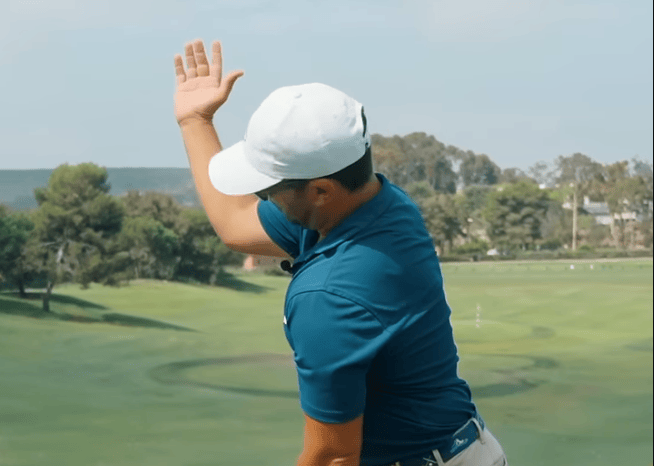
The “serve-the-tray” position at the top of the backswing.
What do we need from the shoulder in the golf swing
To do this drill effectively and get it’s intended result, we need to focus on the trail shoulder in the backswing. From the video above, we see how we need external rotation of the shoulder, scapular retraction, and elbow flexion. Let’s focus on the ability to create external rotation at the shoulder.
Check out this similar article addressing shoulder mobility here:
Shoulder external rotation
We can see how to measure shoulder external rotation availability. We want at least 90 degrees, hopefully a bit more, of shoulder external rotation from the trail side. If we cannot get there, then completing the serve the tray swing drill will be IMPOSSIBLE without compensation somewhere. This usually shows up as loss of posture as we un-hinge the hips to stand more upright, giving us a position that could better hold a tray flat, but now sacrificing the posture angles at the knees and hips. Over-the-top, early extension, and loss of shoulder plane are common swing characteristics that can now appear by trying to achieve this position without having physical access to it. It is also likely these characteristics would be present before, since the shoulder cannot help to achieve the intended plane so the body must warp and manipulate itself to help get there.
So what can we do to specifically work on and improve shoulder external rotation? Try these movements below…
Long sitting reach
This position helps open up and create expansion at the rib cage, the muscles around the scapula, and the capsule of the shoulder joint.
2. Banded shoulder distraction
This move targets the passive restrictions around the shoulder joint, helping to allow the head of the humerous to slide and glide as it needs to in the socket.
Shoulder mobility and scapular protraction/ stability
This test from Titleist Performance Institute helps put a few things together. We are again assessing for shoulder external rotation, but now access to active external rotation alongside scapula mechanics and stability. In the original swing cue video above, we see how the player needs to pull the scapula back to gain a bit more access to the shoulder external rotation. Without strength and stability through the shoulder complex, we will also struggle to make this move to gain more space. Further, it will be difficult to consistently and efficiently create these positions without compensation or deep concentration.
To improve shoulder stability and motor control, try these movements below…
1. DNS 5 month upper body roll
This move does a fantastic job of centrating the shoulder joint, teaching and enforcing the small muscles of the rotator cuff to lengthen and allow rotation, and maintaining good scapular stability all the while.
2. Shoulder flexed banded external rotation
This is a great move to work deep into the shoulder capsule while stabilizing the maintaining neutral shoulder blade position. Here we can influence true shoulder rotation while under load.
3. FRC shoulder external rotation PAILS and RAILS
This is a fantastic way to drive shoulder external rotation and create comfort there, without the ability to compensate. This position has constraints that help us create shoulder external rotation with the proper muscles while the stabilizing muscle are engaged to hold the shoulder blade steady.
Conclusion
The serve the tray swing thought can be a powerful tool—but only when the body has the physical capacity to support it. When shoulder external rotation, scapular control, and joint stability are present, this drill helps organize the trail arm and shoulder into a strong, repeatable top-of-backswing position. When they’re not, the drill often exposes the limitation rather than fixing it.
Forcing the position without access to it typically leads to compensation: early extension, loss of posture, over-the-top patterns, or inconsistent shoulder plane. These aren’t swing faults as much as movement workarounds—your body finding a way to complete the task with the options available to it.
The solution is not to abandon the drill, but to earn it. By improving shoulder external rotation, restoring healthy joint mechanics, and building scapular stability and motor control, the serve the tray concept becomes effortless instead of forced. When the shoulder can rotate, the scapula can stabilize, and the arm can move freely, the backswing organizes itself—and the downswing no longer has to fix what was missed at the top.
If this position feels difficult or inconsistent in your swing, it’s worth stepping away from the mirror and into an assessment of your shoulder mobility and stability. Addressing those limitations off the course is often the fastest way to clean up what you see on the course—and to make classic swing thoughts like serve the tray actually work for you.
Learn more with the comprehensive YouTube video here!
-Dr. Nick DC, MS, TPI, CSCS
If you would like to learn more about your body, pain, and performance, send Dr. Nick an email at contact@integratedrpc.com or call at (585)478-4379, or schedule a FREE discovery visit at Contact.
Instagram @Integrated.Rehab.Performance