Why Golf Club Fittings Matter for Performance and Longevity
Golfers spend countless hours working on their swing, strength, and mobility, yet many continue to struggle with inconsistent ball striking, distance gaps, and recurring swing faults. Often, the issue isn’t effort or instruction — it’s equipment that doesn’t match how the golfer actually moves.
A proper golf club fitting is not about luxury or preference. It is about optimizing performance by aligning equipment with biomechanics, swing dynamics, and impact conditions. When clubs match the player, performance becomes more repeatable, efficient, and sustainable.
Equipment Is Part of the Performance System
Every golf swing is a force-production problem. The body applies force into the ground, transfers it through the kinetic chain, and delivers it into the club at impact. If the club’s length, weight, shaft profile, or lie angle does not match the golfer’s movement pattern, the body must compensate.
These compensations often show up as:
Inconsistent strike location
Loss of ball speed
Directional misses
Increased physical stress on the hands, wrists, elbows, and back
A proper fitting removes unnecessary variables so the golfer can deliver the club more consistently without forcing unnatural movement patterns. Golf fittings also help limit stress and the need for swing compensations that place extra load on the joints and tissues. That’s why as a golf rehab and performance expert, I always recommend instruction and general fitness training for my patients and clients. Club fitting is a part of that instruction process.
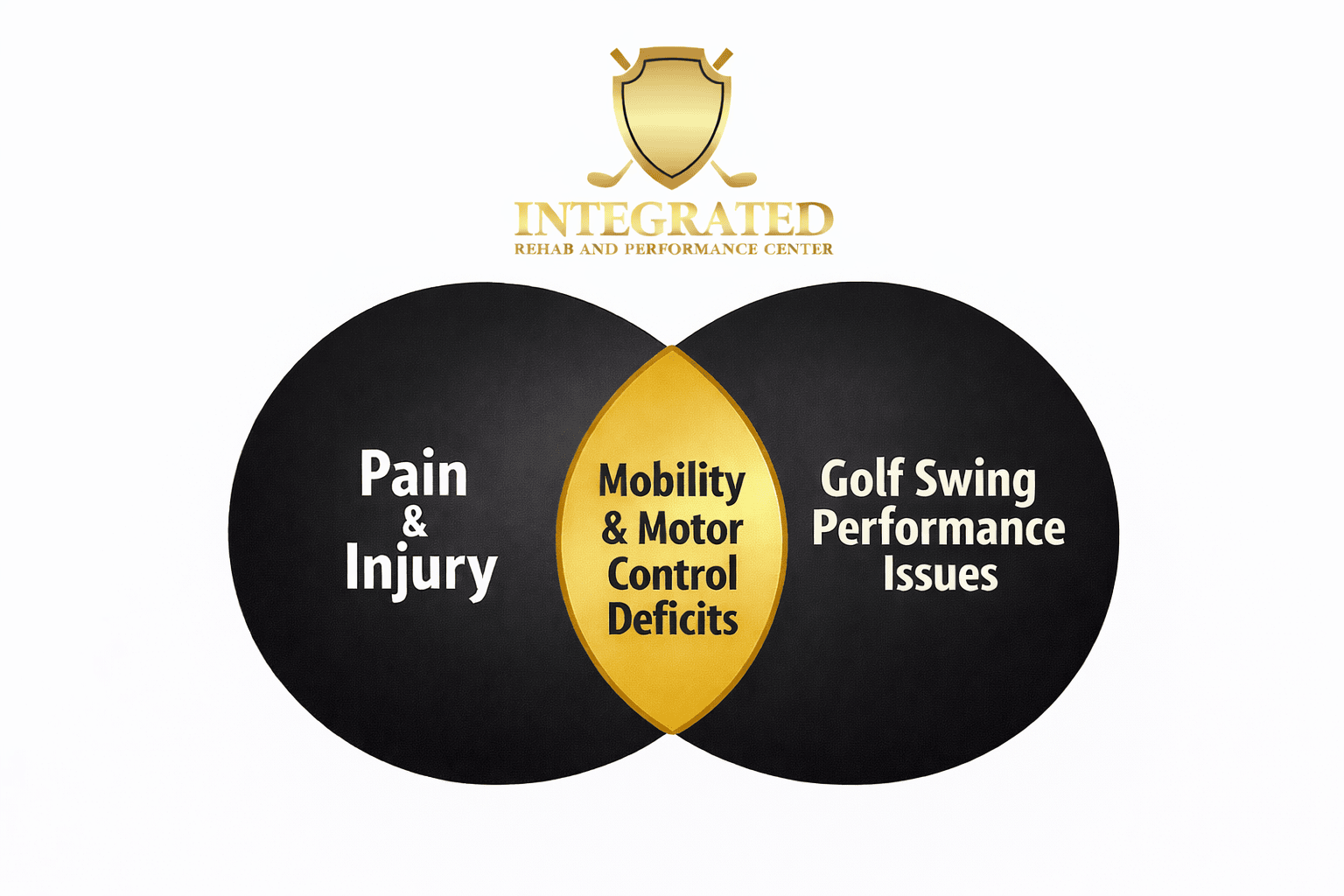
A diagram illustrating the connection between physical restrictions and golf performance and pain/ injury.
For more on this, check out the article linked here on the body swing connection: [The Body Swing Connection]
Why Swing Speed Alone Is Not Enough
Many golfers assume fittings are only about swing speed. While speed matters, it is only one variable. Effective fittings also account for:
Tempo and transition
Angle of attack
Dynamic lie at impact
Face-to-path relationship
Strike location consistency
Two golfers with identical swing speeds may require completely different shafts and head configurations based on how they load the club and deliver it to the ball. Fittings that rely only on static measurements or speed charts miss these critical details.
How Proper Fit Improves Ball Flight and Distance
Distance is not just about swinging harder — it is about efficiency. A fitted club helps the golfer:
Deliver optimal launch angle
Control spin rates
Improve smash factor
Reduce energy loss at impact
When loft, shaft, and head design match the golfer’s delivery, the ball launches higher with less excess spin and better carry. Many golfers gain distance simply by improving efficiency, not by changing their swing.
Accuracy Comes From Dynamic Fit, Not Feel
Accuracy is often blamed on technique, but poor equipment fit frequently plays a hidden role. Incorrect lie angles and shaft profiles can cause the clubface to arrive open or closed relative to the target — even when the swing is sound.
A fitting evaluates dynamic impact conditions, not just how the club looks at address. This ensures:
More centered face contact
Tighter dispersion patterns
Reduced left-right misses
When the club returns to impact in a predictable way, the golfer can trust their swing and commit fully to shots.
Injury Risk and Physical Stress Matter
Ill-fitted clubs do more than hurt performance — they can increase physical stress. Clubs that are too long, too heavy, or too stiff often force excessive grip tension, altered posture, or early extension.
Over time, this can contribute to:
Wrist and elbow irritation
Shoulder fatigue
Low back stress
Reduced swing longevity
Properly fitted equipment allows the golfer to move more naturally, distribute forces efficiently, and reduce unnecessary strain during repetitive swings.
Fitting Is Not a One-Time Event
A golfer’s body and swing change over time. Strength gains, mobility improvements, injury recovery, or technical changes can all alter how a club should fit.
This is why high-level players reassess equipment regularly. Even recreational golfers benefit from periodic fittings to ensure their clubs still match their current capabilities, not who they were years ago.
The Bottom Line
Golf club fittings are not about chasing perfection or buying new equipment for the sake of it. They are about removing barriers to performance.
When equipment fits the golfer:
Ball flight becomes more predictable
Distance improves through efficiency
Swing consistency increases
Physical stress decreases
Golf is already difficult enough. Playing with equipment that works against your movement only makes it harder. A proper fitting allows the golfer’s training, coaching, and physical preparation to show up on the course — where it actually matters.
Fitness, rehab, and instruction. Make sure you are addressing all three components for a longevity based golf career!
Check out Golf Podcast Episode 53 for more details on club fittings, the metrics that are considered, and all the variables that can be manipulated to find the best equipment for you!
-Dr. Nick DC, MS, TPI, CSCS
If you would like to learn more about your body, pain, and performance, send Dr. Nick an email at contact@integratedrpc.com or call at (585)478-4379, or schedule a FREE discovery visit at Contact.
Instagram @Integrated.Rehab.Performance